History Lesson: What Is a .sdc File? StarOffice Calc Spreadsheet
StarCalc / StarOffice Calc’s binary spreadsheet — not OpenOffice.org XML .sxc, and not OpenDocument .ods.
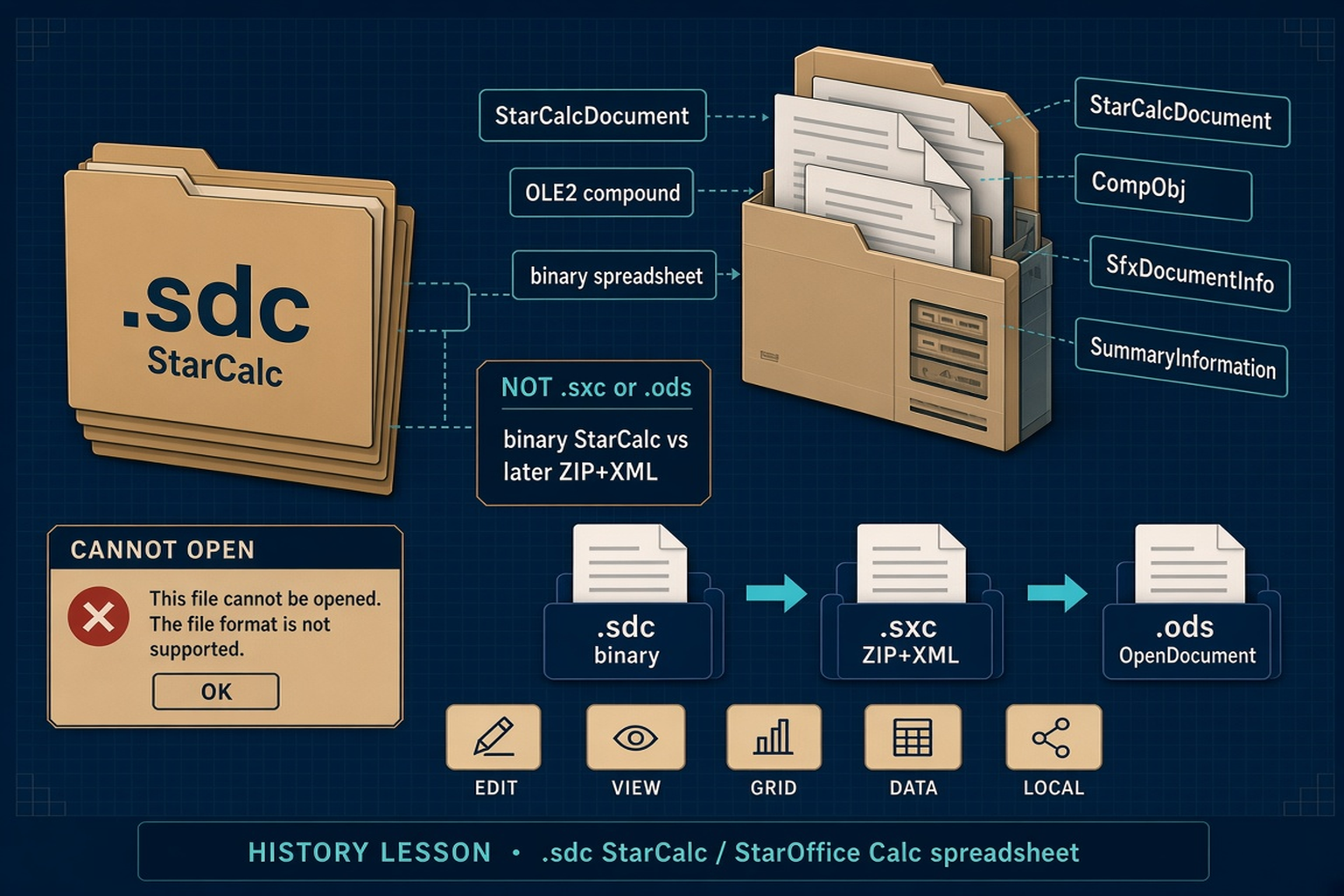
TL;DR
A .sdc is a StarCalc / StarOffice Calc binary spreadsheet (MIME application/vnd.stardivision.calc) from the StarOffice ~3.x–5.x era. It is not OpenOffice.org XML .sxc, and not OpenDocument Spreadsheet .ods. Modern Microsoft Excel will not open it. Legacy File Converter converts .sdc locally on Windows to modern targets such as XLSX and CSV — nothing is uploaded.
What is a .sdc file?
A .sdc file is a spreadsheet from StarCalc, the spreadsheet that shipped inside StarOffice during the suite’s binary era (roughly StarOffice 3.x–5.x). The Internet media type is application/vnd.stardivision.calc — OpenOffice.org’s own MIME notes list that type for StarCalc 5.x with the .sdc extension. Just Solve / Archiveteam’s StarOffice binary-formats table points at UK National Archives PRONOM records fmt/808, fmt/809, and x-fmt/359 for StarOffice Calc binaries. The same binary family also includes .sdw (Writer), .sdd (Impress), .sda (Draw), .vor templates, and siblings — this article is about Calc .sdc only.
The product line starts in 1985. Marco Börries wrote StarWriter 1.0 for the Zilog Z80 and formed Star Division in Lüneburg the following year (Wikipedia StarOffice). Spreadsheet work arrived as the suite grew: Wikipedia’s version table lists StarOffice 2.0 (1994) with StarWriter, StarCalc, and StarBase for Windows 3.1, then StarOffice 3.0 (1995) with StarCalc among Writer, Draw, Image, and Chart across MS-DOS, Windows 3.1, OS/2, Solaris SPARC, and a Power Macintosh path. Star Division marketed primarily in Europe, later from Hamburg, with contemporary U.S. coverage also describing a Fremont, California presence after the company moved stateside.
Why it spread: European offices, Linux / Solaris shops, and Windows PCs that never standardized on Excel needed a full suite — word processor, spreadsheet, and presentation — without buying Microsoft Office for every seat. In 1998, Star Division began offering StarOffice for free. In August 1999, Sun Microsystems acquired Star Division; contemporary coverage and later summaries put the deal near US$73.5 million. Sun released most of the source as OpenOffice.org around 2000; later StarOffice builds were snapshots of OOo plus proprietary bits. Oracle acquired Sun in January 2010; the product briefly became Oracle Open Office, was discontinued in 2011, and the OpenOffice.org line continued on a community path while forks carried the codebase forward.
.sdc ≠ .sxc ≠ .ods
Binary StarCalc (.sdc) is not the later OpenOffice.org XML package (.sxc), and neither is OpenDocument Spreadsheet (.ods). Renaming the extension does not convert the file.
Is a .sdc the same as .sxc or .ods?
No — and that three-way mix-up is why these legacy files keep landing in “what is this?” searches. StarOffice 5.2 (about 20 June 2000) was the last major line still rooted in the old binary suite era and the first major Sun release (Wikipedia version table). StarOffice 6.0 (about May 2002, based on OpenOffice.org 1.0) moved Calc to a ZIP+XML package with the .sxc extension — OpenOffice.org XML, not the old compound binary. OpenOffice.org’s XML FAQ lists .sxc as the Calc default for that generation. Later, OpenDocument Spreadsheet (.ods) became the open-standard path (StarOffice 8 / OpenOffice.org 2.x era).
So the generation shift is: .sdc (binary StarCalc) → .sxc (OOo XML package) → .ods (OpenDocument). Same product family over time; three different on-disk packages. A text editor will not turn a .sdc into readable spreadsheet XML. Changing .sdc to .sxc or .ods in Explorer does not convert anything.
Microsoft Excel has no built-in StarCalc .sdc importer for everyday users. Double-clicking a .sdc in 2026 fails as unsupported — not because the cells are empty. You need a conversion path to a modern workbook such as XLSX or a values dump such as CSV. Do not expect perfect fidelity for every 3.x dialect, charts, or macros.
Not Excel’s .xls either
Classic Excel .xls is a different binary lineage (often BIFF — Binary Interchange File Format — inside an OLE compound file). A .sdc may also be an OLE2 package, but the streams and cell encoding belong to StarCalc — renaming .sdc to .xls does not make Excel understand it.
How the bytes work (OLE2 / StarCalcDocument)
On disk, many StarCalc 4.x/5.x .sdc files are an OLE2 / Compound File — spell that out as Object Linking and Embedding version 2 compound file (structured storage). That is the same low-level container idea as classic Microsoft .xls / .doc, not a claim that the workbook is an ActiveX control. Community format notes (and FilExt-style compound-file summaries) document streams such as StarCalcDocument, CompObj, SfxDocumentInfo, and SummaryInformation, with optional macro-related streams in some workbooks.
The spreadsheet payload lives in the StarCalcDocument stream as a proprietary binary grid of values, formulas, and formatting — not as OpenDocument content.xml. Earlier StarCalc dialects used different binary layouts; if a file does not open as a clean compound document, treat it as an older binary dialect rather than assuming corruption. Either way, the distinctive point is the same: .sdc is a StarCalc-native binary, not a ZIP of XML.
Extension collisions
Other unrelated programs have also used an .sdc extension for non-spreadsheet data. If the file is not an OLE2/StarCalc workbook, MIME type application/vnd.stardivision.calc and StarCalcDocument-style streams will not apply — identify by contents, not by letters alone.
Sun, OpenOffice.org, and why .sdc files still sit on disks
European, Linux, Solaris, and Windows StarOffice deployments in the late 1990s and early 2000s, free personal downloads after 1998, and corporate migrations that never finished all left folders labeled “StarOffice” or “StarCalc.” Budget sheets, lab tables, school assignments, and side projects saved as .sdc outlived the machines that created them. After Oracle discontinued commercial Oracle Open Office, there was no remaining Sun/Oracle vendor path aimed at everyday Excel users who inherit those archives.
An Excel window that refuses .sdc is not proof the workbook is empty. A hex dump that starts like an OLE2 compound file is not proof you can paste the cells into a modern sheet. These are legacy files from a product line that moved through binary StarCalc, OpenOffice.org XML, and OpenDocument — and then lost its commercial vendor brand.
Legacy File Converter lists StarOffice Calc / .sdc among supported spreadsheets on Supported File Types and converts .sdc locally on Windows to modern targets such as XLSX · CSV and related spreadsheet outputs. Nothing is uploaded — see also Convert Legacy Files Without CloudConvert. For the matching Writer story in the same suite, see History Lesson: StarWriter (.sdw); for Excel’s own binary lineage, see History Lesson: Excel .xls.
Related reading
Ready to open your old files?
Download the free trial and convert your first files today — fully offline, no original software required.
Free trial
Full app features · up to 10 files
Windows 10 or 11
Same free trial as always — download the Windows installer and convert locally on your PC.
Direct Windows installer · offline MSI
Is this safe? — publisher, installer, and SmartScreen help
Requires Windows 10 or 11. No subscriptions. 100% Windows Native.