
History Lesson: What Is a WordStar File? Legacy .ws Word Will Not Open
Legacy MicroPro manuscripts. Not a Windows script, not WordStar 2000, and Word will not open them.
TL;DR
A WordStar file is a legacy MicroPro International document from the early PC era — CP/M (Control Program for Microcomputers) and later MS-DOS. A legacy .ws is not a Windows script. Before version 5.0, high-bit wrap flags on in-margin words make the text look garbled in a modern editor. WordStar 2000 is a different, incompatible format. Current Microsoft Word will not open them.
What is a WordStar file?
A WordStar file is a legacy document from MicroPro International's word processor, first shown at the West Coast Computer Faire in April 1979 and sold that June, on Digital Research's CP/M. Seymour Rubinstein had left IMSAI (he had been director of marketing) and founded MicroPro in 1978; he hired John Robbins (Rob) Barnaby to write the program. The Library of Congress format description still treats WordStar as one of the most influential early microcomputer word-processing formats.
WordStar did not lock you to .ws. The 1983 WordStar Reference Manual (p. 1-12) told users to pick a name they would remember. An optional period and one-to-three-character extension could describe the type — .LET for a letter, .REP for a report, even .912 for the last editing day. The one extension to avoid was .BAK, because WordStar wrote backups there. The Library of Congress's own holdings use .ws, .wsd, .ws5, .ws6, and .ws7. WordStar for Windows later favored .wsd. A legacy file with no extension at all can still be WordStar.
Why a legacy .ws is not a Windows script (and Word will not open it)
FileInfo and similar catalogs treat .ws as a Windows Script. Microsoft's Windows Script Host more commonly uses .wsf. A legacy WordStar .ws is a manuscript, not a script — do not double-click it expecting Word, and do not assume it is malware just because catalogs warn about scripts.
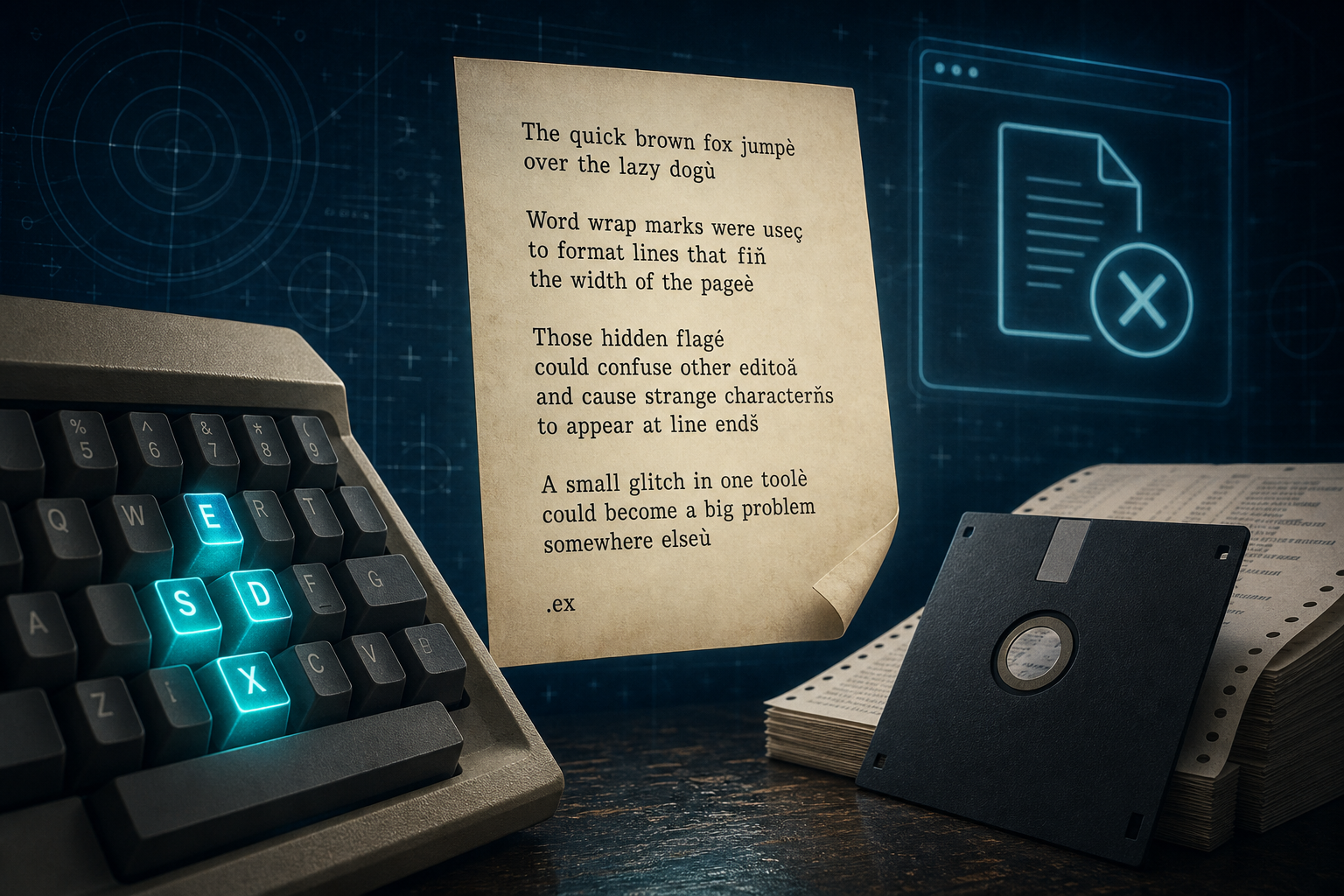
Open an old WordStar document in Notepad and the last letter of many words turns into an accented character. That is not corruption. The official File Format for WordStar Release 7.0, published by WordStar International on 17 March 1992, explains the bytes. Printable text is 7-bit ASCII. Codes below 20h and the 8th bit carry formatting. A hard paragraph ends with 0Dh, 0Ah. A soft return — a word-wrap break — is 8Dh, 0Ah. A soft space (A0h) marks tabs, justification, and left-margin indent. Before WordStar 5.0, the high bit was set on the last character of every non-blank string that fell inside the margins so printer drivers could microjustify the line. Version 5.0 dropped that trick for absolute tabs, margin dot commands, and paragraph styles. Until you strip the high bits, a UTF-8 editor reads those last letters as Latin-1 junk.
Formatting also lives in dot commands: a period in column 1 plus two letters on their own line. .PA starts a new page. .LM and .RM set left and right margins. They take space on the screen and none on the printed page. WordStar also had document mode (embedded controls) and nondocument mode (plain ASCII, used as a programming editor — no high-bit flags). The Library of Congress notes that Microsoft Word 2003 and earlier shipped a WordStar converter. Microsoft's Office 2000 Converter Pack listed Wrdstr32.cnv for WordStar 3.x–7.x for MS-DOS and WordStar for Windows 1.0–2.0, import only. That pack is gone from current Word. Windows Write (.wri) is a different Microsoft format — not WordStar.
WordStar vs WordStar 2000 — two products, two formats
WordStar 2000 was released in 1985 with a completely different, incompatible file format (UK National Archives PRONOM fmt/882). The name is not a year-2000 edition of classic WordStar. Classic WordStar resumed as WordStar 4 in February 1987 after MicroPro acquired NewStar / NewWord.
The Ctrl-key diamond
WordStar reached MS-DOS and the IBM PC in 1982. The MicroPro WordStar 3.2 addendum's first issue is dated 15 April 1982. The PC already had arrow keys. WordStar kept the Ctrl-key diamond anyway: Ctrl-E up, Ctrl-S left, Ctrl-D right, Ctrl-X down — the four keys under the left hand on a typewriter keyboard. Touch typists never left the home row. In BYTE (May 1983), Richard S. Shuford called WordStar the best-known and probably most widely used personal-computer word processor, with a list price of $495. Robert J. Sawyer described that diamond in *WordStar: A writer's word processor* (Ars Technica, 16 March 2017). The same Ctrl sequences spread into other DOS tools.
After the lead, a different product, a different company
After WordStar 3.3 in 1983, MicroPro went years without a classic-line update until the February 1987 return. Versions 5, 6, and 7 grew the file format (headers, symmetrical sequences, Star Exchange). In May 1989 MicroPro renamed itself WordStar International. On 4 February 1994 that company completed a three-way combination with SoftKey Software Products and Spinnaker Software and became SoftKey International. The legacy files on disks and in archives are still the 1979–1990s documents, not a modern Word file with a cute extension.
Why these files are still on disks
The Library of Congress holds several hundred WordStar files in Special Collections. Writers stayed. George R. R. Martin has said in his own Not A Blog that he wrote his fiction on a DOS machine running WordStar 4.0 — in 2007, again in 2011 ("the Duesenberg of word processing software"), and still in April 2020. Arthur C. Clarke wrote the 1982 sequel to *2001: A Space Odyssey* on an Archives III microcomputer running WordStar; Matthew G. Kirschenbaum records that last-minute corrections went out through the Padukka Earth Station and the Indian Ocean Intelsat V. The Library of Congress also names Anne Rice among the format's literary users.
Those manuscripts are still on floppies, old hard disks, and zip archives because WordStar never required a telltale extension and because current Word will not open the stream.
Related reading
Ready to open your old files?
Start free, then unlock unlimited conversions with a one-time $79.95 Standard license. Download the Windows installer — full features for up to 10 files.
Free trial
Full app features · up to 10 files
Windows 10 or 11
Same free trial as always — download the Windows installer and convert locally on your PC.
Direct Windows installer · offline MSI
Is this safe? — publisher, installer, and SmartScreen help
Requires Windows 10 or 11. No subscriptions. 100% Windows Native.