
History Lesson: WordPerfect and the .wpd File
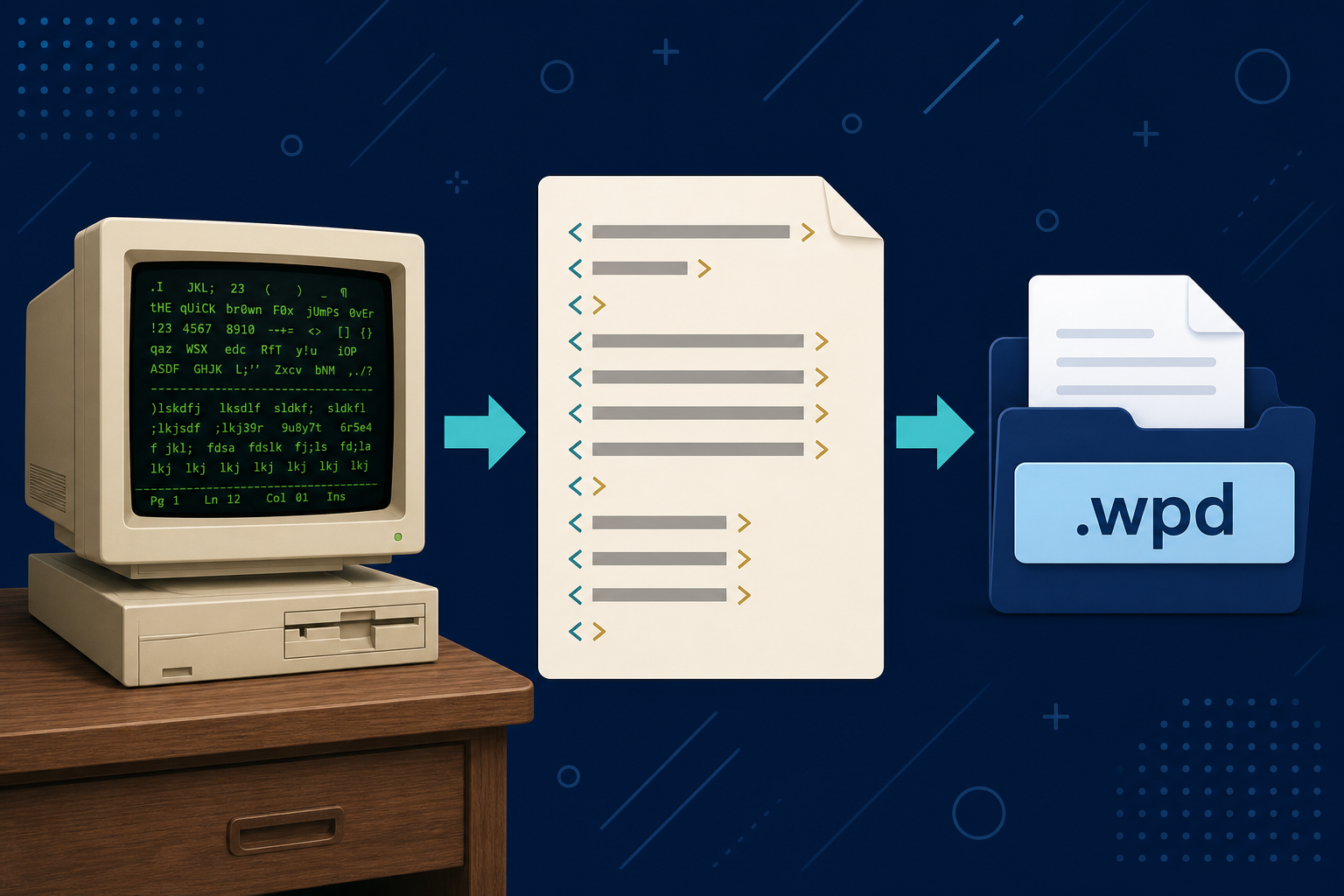
A blank DOS screen, a streaming-code document, and the Utah word processor that ran law firms for a generation.
TL;DR
WordPerfect grew out of a Data General word processor designed for the City of Orem, Utah — work Alan Ashton drafted in 1977 and Bruce Bastian joined in 1978, kept as their own IP, then shipped by Satellite Software International from 1979. The IBM PC port (26 November 1982) and especially DOS 5.1 (1989) made .wpd the default document in many legal offices. Reveal Codes and a huge printer-driver library were the product. Microsoft Word and Office bundling took the market in the 1990s; Novell, then Corel, inherited the format. The files are still on disks. Word 2016 and later will not open them with the old converters. Legacy File Converter reads .wpd locally on Windows.
A word processor for a city, not a magazine cover
Alan Ashton, a computer science professor at Brigham Young University, drafted the design in 1977. Bruce Bastian — a music student turned CS graduate student — joined him in 1978. The paying job ran through Eyring Research, under Eyring's contract to put a Data General system in the City of Orem, Utah. Ashton and Bastian kept the intellectual property. It was not a BYU product.
Satellite Software International (SSI) incorporated in September 1979. Don Owens joined as the third founder, on the marketing side. The first commercial product, SSI*WP, shipped in March 1980 for Data General systems at a list price of US$5,500. It was not a consumer toy. It was office software sold into minicomputer shops.
The IBM Personal Computer changed the addressable market. On 26 November 1982, SSI shipped the IBM PC port under the name WordPerfect, version 2.20. Through version 5.0 the PC program was written in x86 assembly. Version 5.1 moved more of the work into C. That is one reason DOS WordPerfect felt fast on hardware that made other word processors crawl.
Why the screen was empty
Wang and other dedicated word processors painted the screen with control codes. WordPerfect's early DOS versions did the opposite: a nearly blank page and a status line. Formatting lived in the file, not as clutter on the glass. Commands were function keys. Menus arrived later.
That blankness was a feature. Typists who had used a typewriter recognized the page. Power users memorized the keyboard template that came in the box. Classic WordPerfect put Help on F3 and Cancel on F1 — the reverse of what Windows later trained everyone to expect. Press F3 twice and the program drew the on-screen key map that the plastic overlay sat on.
Printers were the product
DOS did not give applications a standard way to talk to a printer. WordPerfect did. From version 3.0 onward, SSI shipped its own printer drivers. By the 5.1 era the list ran to hundreds of printer drivers. Law offices bought WordPerfect because the brief came out of the laser printer looking like the brief.
Version 4.2, in 1986, is the release most historians point to as the moment WordPerfect passed WordStar in the U.S. DOS market. Automatic paragraph and line numbering, footnotes, and tables of authorities were not extras. They were why a firm standardized on one program.
The company took the product's name around 1986 and became WordPerfect Corporation. Support scaled with the product: by July 1991, Utah support HQ was taking more than 16,000 calls a day, with live DJs — "hold jockeys" — in a booth keeping callers company.
5.1, November 1989
WordPerfect 5.1 for DOS, released in November 1989, is the version people still mean when they say "WordPerfect." Pull-down menus (optional), tables, print preview, and that printer library. Styles had already arrived in 5.0, riding on the same stream of codes. A generation of paralegals, court clerks, and municipal staff learned 5.1 and never fully left it. Some offices ran it into the 2000s because it did one job and did not surprise them.
Reveal Codes, and what a .wpd actually is
Reveal Codes is the feature Word never copied in a way that satisfied WordPerfect people. Split the window and you see the document as a stream: text interrupted by on/off function codes. Bold starts, bold ends. A bad indent is a code you can delete. The idea is closer to HTML than to Word's hidden object model — except the codes are binary, not angle-bracket text you could edit in Notepad.
That streaming-code design is the .wpd format. Early files often had no extension, or used .wp. Later versions settled on .wpd, with some version-specific names (.wp4, .wp5, .wp6, .wp7). Broadly, there are three generations:
- 4.x — essentially ASCII with embedded function codes and no magic header.
- 5.x — binary with a 16-byte prefix and magic bytes FF 57 50 43 (ÿWPC).
- 6.x — still ÿWPC, but a different version byte and a larger packet/index structure.
WordPerfect 5.1 cannot natively read 6.x files; the later 5.1+ release can, via its converter (CV.EXE). From 6.0a forward, later Windows WordPerfect generally reads the family and ignores unknown codes. Going the other way was harder: an older WordPerfect simply did not know the new codes.
Two quiet properties of that design still matter in archives:
- WordPerfect macros lived outside the document. The file was less of a malware vehicle than a Word .doc with an embedded macro.
- Microsoft Word through Word 2013 could use installable WordPerfect converters. Word 2016 and later no longer use those converters. A file that opened in Word 2003 can sit unread in Word 2021.
Windows, Novell, Corel
WordPerfect for Windows 5.1 arrived in 1991, late and unsteady compared with the DOS product people loved. Microsoft bundled Word with Office. The default document in American offices flipped in a few years.
WordPerfect Corporation sold the business to Novell in 1994. Corel bought WordPerfect from Novell in January 1996. Corel still ships WordPerfect Office. The line did not die. It left the center of the market.
Governments and courts were slower to leave. The U.S. Department of Justice extended WordPerfect in 2005 for more than 50,000 seats. U.S. federal courts, for their part, moved toward Word and PDF by around 2016. France's judiciary was still using and training on WordPerfect as of 2022–24. Law firms kept matter files in .wpd because that is what the work was written in.
Bruce Bastian died on 16 June 2024, at age 76.
The files are still there
A .wpd on a share from 1994 is not a curiosity. It is a contract, a pleading, a city ordinance, a sermon, a dissertation. The application that created it may be gone from the PC. Word will often refuse it. The bytes are still a WordPerfect document.
If you need those pages in Word or as a PDF, convert them on this PC. Do not upload a legal archive to a random website.
Legacy File Converter reads .wpd (and the rest of a mixed pile) locally on Windows and writes DOCX, PDF, and other modern formats. Nothing is uploaded.
Skip random online converters
Legal, municipal, and family WordPerfect files should stay on the machine that already has them.
Add .wpd files or a folder
Drop individual WordPerfect documents or point at an archive folder.
Choose DOCX or PDF
DOCX for editing in Word; PDF for a frozen archival copy.
Convert offline
Everything stays on this PC. Nothing is uploaded.
Convert your files
Related reading
Ready to open your old files?
Start free, then unlock unlimited conversions with a one-time $79.95 Standard license. Download the Windows installer — full features for up to 10 files.
Free trial
Full app features · up to 10 files
Windows 10 or 11
Same free trial as always — download the Windows installer and convert locally on your PC.
Direct Windows installer · offline MSI
Is this safe? — publisher, installer, and SmartScreen help
Requires Windows 10 or 11. No subscriptions. 100% Windows Native.