
History Lesson: What Is a .cr2 File? Canon RAW
Canon’s TIFF-based camera RAW — not a finished JPEG, not CR3, and not Adobe DNG.
TL;DR
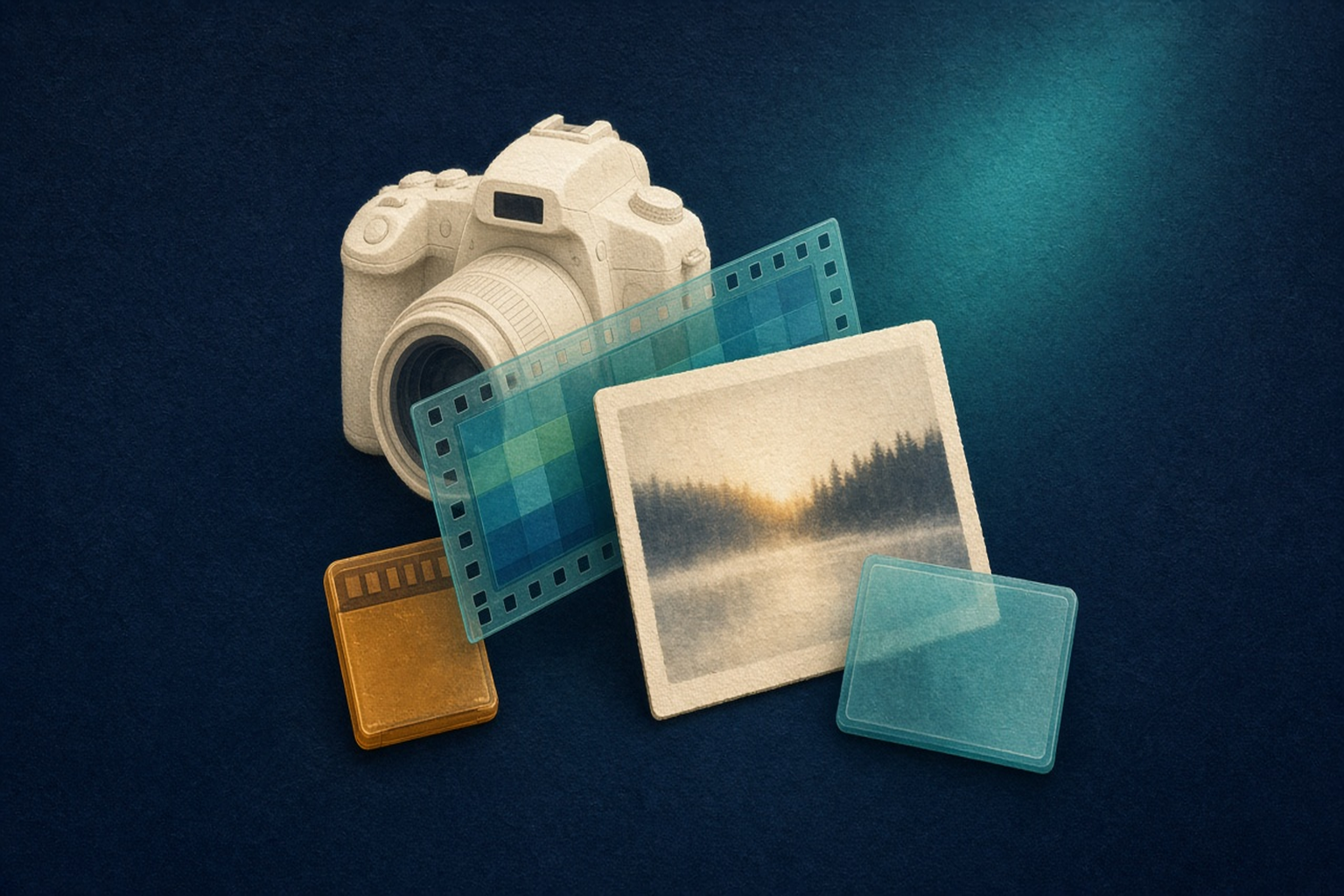
A .cr2 is Canon RAW version 2 (CR2): Canon’s proprietary camera RAW format. Spell RAW as the near-sensor capture — a minimally processed sensor readout, often called a “digital negative,” not a finished JPEG. On disk the extension is .cr2 (also .CR2). CR2 is a TIFF-based (Tagged Image File Format) container with IFD (Image File Directory) structures holding previews plus the full Bayer CFA (Color Filter Array) mosaic payload, Exif metadata, and Canon MakerNotes. Canon EOS cameras (and some PowerShot bodies) have written CR2 since about 2004, superseding older CRW. It is not CR3, and not Adobe DNG. Legacy File Converter converts listed camera RAW extensions including CR2 locally on Windows to JPG or PNG — nothing is uploaded.
What is a .cr2 file?
A .cr2 file is Canon RAW version 2 — the proprietary camera RAW package Canon’s EOS digital bodies (and some PowerShot models) wrote for years. Think of it as the capture kept for later demosaic (turning the Bayer mosaic into a full-color image) and tone work, not a social-ready JPEG. Early CR2-writing bodies commonly cited include the EOS 20D, 350D / Digital Rebel XT, 1D Mark II, and G9. The format replaced older CRW (Camera Image File Format / CIFF-based Canon RAW) used on earlier bodies such as the D30, D60, 10D, and 300D.
Under the hood, CR2 organizes bytes as a TIFF / IFD structure. After the standard 8-byte TIFF header comes a distinctive CR2 marker: literal ‘CR’, major version 2, minor 0, plus an offset to the IFD that holds the RAW data. Typical files carry multiple IFDs — JPEG previews or thumbnails plus the full-dimension RAW payload (often described as about four IFDs, with the full RAW in a later IFD). Sensor samples are commonly 12- or 14-bit per channel versus JPEG’s 8-bit, and the mosaic is often compressed with lossless JPEG. Some CR2-era models also offered smaller M-RAW / S-RAW options.
Not a generic photo
A .cr2 is TIFF-based Canon camera RAW with sensor mosaic data and MakerNotes. It is not a drop-in JPEG or PNG you can open in every Photos window without a raw pipeline.
Why won’t Photos or Windows open CR2?
Because CR2 is camera RAW, not a finished display image. Windows Photos, File Explorer, and many browsers often have no native CR2 decoder path, so the file can show a blank or generic icon even when the capture is intact. That blank preview is a missing codec / raw pipeline problem — not proof the shoot is empty. You need software that understands Canon’s TIFF-based RAW package (or a converter that turns it into JPG or PNG for everyday viewing).
Blank preview ≠ empty file
A generic icon in Explorer or a Photos failure does not mean the .cr2 is corrupt or blank. It usually means the OS viewer has no CR2 pipeline.
CR2 vs CR3 vs DNG
CR3 is Canon’s later RAW format. Canon introduced .CR3 with DIGIC 8, first on the EOS M50 (announced around February 2018), including a C-RAW (Compact RAW) option. Until DIGIC 8 / EOS M50, Canon cameras saved RAW as .CR2. CR3 uses a different container family — ISOBMFF (ISO Base Media File Format / QuickTime-family, the same broad family as MP4 / HEIF) — while CR2 stays TIFF-based. Older CR2 cameras do not firmware-upgrade into shooting CR3; the format is tied to the camera generation.
DNG (Digital Negative) is Adobe’s open, documented RAW container (announced 2004). It is a separate format from CR2. Photographers often convert CR2 → DNG via Adobe’s DNG Converter or Lightroom for archival interchange. Conversion can remap or lose some Canon MakerNotes, so keep CR2 masters when Canon-specific tags matter. Renaming .cr2 to .dng does nothing useful.
CR2 ≠ CR3 ≠ DNG
Same brand lineage does not make CR2 and CR3 the same on-disk package. Adobe DNG is an open archive path — not a rename of Canon RAW.
Where CR2 came from (Canon EOS digital era, ~2004)
CR2 arrived with Canon’s mid-2000s digital EOS wave. Sources place CR2 production since about 2004, with early bodies such as the 20D, 350D / Digital Rebel XT, and 1D Mark II commonly cited, and CRW replaced by CR2 starting with the EOS 20D in 2004. Through the widely used Canon DSLR era that followed — more than a decade of bodies writing CR2 — photographers filled CF/SD cards, backup drives, and catalogs with these files. Hedge the market story: say Canon bodies that wrote CR2 were everywhere in that era, without inventing market-share percentages.
Why .cr2 files still sit on disks in 2026
By 2026, .cr2 still shows up from wedding and event archives, travel cards, Lightroom catalogs, “old camera still in the closet” backups, and decade-plus of Canon DSLR shoots. Newer Canon bodies moved to CR3, but the CR2 masters remain. Windows may still show a blank icon without a raw pipeline. These are legacy files in the everyday sense: still valuable captures, often confusing next to JPEGs, and easy to leave stranded on an old drive.
Legacy File Converter converts CR2 and other listed camera RAW extensions (CR3, DNG, NEF, ARW, and related family members on Supported File Types) locally on Windows to JPG or PNG. Nothing is uploaded. This article stays the history; for practical open-and-convert steps, see Opening RAW Camera Files Without the Camera Software. For neighboring RAW and “photo that is not a JPEG” lessons, see History Lesson: What Is a .dng File? Adobe’s Digital Negative and History Lesson: What Is an .avif File?.
Related reading
Ready to open your old files?
Start free, then unlock unlimited conversions with a one-time $79.95 Standard license. Download the Windows installer — full features for up to 10 files.
Free trial
Full app features · up to 10 files
Windows 10 or 11
Same free trial as always — download the Windows installer and convert locally on your PC.
Direct Windows installer · offline MSI
Is this safe? — publisher, installer, and SmartScreen help
Requires Windows 10 or 11. No subscriptions. 100% Windows Native.